Colorado Children’s Campaign releases 2025 KIDS COUNT in Colorado! Data Book
DENVER - The Colorado Children’s Campaign is pleased to release the 2025 KIDS COUNT in Colorado! Data Book. This annual report tracks child well-being at the state and county levels in health, K-12 education, early childhood, and economic security.
The 2025 KIDS COUNT report highlights the growth of Colorado’s developing early childhood system; the responsiveness of public health programs to a changing policy and economic environment; and improvements in school attendance and graduation rates.
However, it also finds a significant number of children experiencing homelessness and living in households that are struggling to make ends meet. Test scores in both reading and math remain lower than before the pandemic, and the state is seeing troubling trends in use of early prenatal care and in oral health.
“Kids and families in Colorado are benefiting from the state’s investments in their well-being. That includes access to preschool through the universal preschool program, support for family bonding through FAMLI, and public health coverage through Medicaid or CHP+,” said Maya Gould, Vice President of Research at the Colorado Children’s Campaign. "But too many children are growing up in households facing precarious financial situations – and we know that can affect a child’s current and future opportunities and well-being," she said.
The 2025 KIDS COUNT in Colorado! Data Book finds that although the median income in Colorado is higher than in most states, nearly 30% of families in Colorado are facing financial insecurity, according to a new analysis from the United Ways of Colorado. And the number of children experiencing homelessness increased significantly between 2023 and 2024 according to multiple data sources.
“When we understand the problems children are facing, we can work as a community to solve them,” said Heather Tritten, President and CEO of the Colorado Children's Campaign. “The KIDS COUNT in Colorado! Data Book brings together information from a wide range of sources to help us understand what’s working well and opportunities for Colorado’s children.”
KIDS COUNT in Colorado! is part of the Annie E. Casey Foundation's national KIDS COUNT project and complements the 2025 national data book, which will be released in June 2025. KIDS COUNT serves as an important source of information on children and families for decision-makers and child advocates.
This year’s project was also made possible through the support of The Anschutz Foundation, the Buell Foundation, El Pomar Foundation, and the Jay & Rose Phillips Family Foundation of Colorado.
County information: The report includes county data sheets that offer snapshots of how each of Colorado’s counties is faring across a range of data indicators. These data sheets are included in the PDF of the report and will be available online.
Print copies: Print copies of the report in English and Spanish, including county data profiles, are available by request.
Release Information: Please contact Vice President of Communications Jackie Zubrzycki at jackie@coloradokids.org if you would like more information or to arrange an interview.
About the Colorado Children’s Campaign: The Colorado Children’s Campaign is a nonprofit, nonpartisan advocacy organization committed since 1985 to realizing every chance for every child in Colorado. We advocate for the development and implementation of data-driven public policies that improve child well-being. For more information, please visit coloradokids.org.
About the Annie E. Casey Foundation: The Annie E. Casey Foundation creates a brighter future for the nation’s young people by developing solutions to strengthen families, build paths to economic opportunity and transform struggling communities into safer and healthier places to live, work and grow. For more information, visit www.aecf.org. KIDS COUNT® is a registered trademark of the Annie E. Casey Foundation.

Statement: The "Big, Beautiful Bill" Will Create Big Problems for Colorado Kids
Last night, the House of Representatives passed a bill that would cause Colorado children to lose health coverage and make it harder for families to afford medical care, food, and other basic needs.
This bill cuts federal spending on programs that support kids and would create new strains on our state’s budget. If it passes, Colorado will struggle to support K-12 education, early childhood, and other programs that help kids learn, grow, and flourish – and that help make our communities work for everyone.
Investing in kids’ well-being pays off – but this bill prioritizes tax breaks for well-off adults at the expense of our ability to care for children.
Four of Colorado’s congressional representatives voted to support this bill, which passed by one vote.
- In Rep. Lauren Boebert’s district, nearly 45,000 children were enrolled in Medicaid in 2024 and over 9,000 households with children received SNAP
- In Rep. Jeff Hurd’s district, more than 78,000 children were enrolled in Medicaid and nearly 18,000 families received SNAP
- In Rep. Gabe Evans’ district, more than 86,000 children were enrolled in Medicaid and 16,500 families received SNAP
- In Rep. Jeff Crank’s district, 65,000 children were enrolled in Medicaid and more than 13,000 households with children received SNAP
The Colorado Children’s Campaign calls on our state’s senators to oppose these cuts and create a budget that helps kids and communities thrive.
“This budget bill will be bad for kids’ health, bad for the financial stability of families and communities, and bad for the quality and efficiency of our government,” said Toni Sarge, Director of Health Policy at the Colorado Children’s Campaign. “Even one child losing the ability to go to the doctor or have enough to eat is one child too many – and this bill will likely result in thousands of Colorado children going without.”
“We can be proud of our efforts to make sure children can get food and medical care when they need it,” she said. “Cuts at this scale will lead to real, negative changes in Colorado’s ability to provide a wide range of services and supports for all of our state’s children, now and in the future.”
Things to know about federal funding and Colorado kids
- Federal funding has played a critical role in helping Colorado meet the basic needs of children in our state.
- The bipartisan advocacy group First Focus on Children estimates that current budget proposals could end 30% of our nation’s investment in children and nearly 50% of its investment in babies and toddlers.
- Federal support for Medicaid has helped bring Colorado’s uninsured rate for children below 5% - down from 13% in 2013.
- Nearly 580,000 Colorado children are enrolled in Medicaid. Medicaid covers about two in five births in the state.
- The families of about one in four Colorado children use the Supplemental Nutrition Assistance Program (SNAP) to help afford groceries.
- More than 15,000 kids have health coverage through Cover All Coloradans, which provides coverage regardless of immigration status. Regardless of the fact this program is funded entirely by state dollars, this bill would penalize Colorado with a significant drop in federal funding if Colorado continues to offer it.
- The new bill would likely raise premiums for families who get their health coverage through Colorado’s health insurance marketplace, Connect for Health Colorado. These changes could return us to a situation where health insurance is unaffordable for many middle-income families.
The Colorado Children’s Campaign Celebrates the Legislature’s Investment in Children During the 2025 Legislative Session
DENVER - Despite a more-than-$1 billion budget shortfall, legislators developed and approved plans to support K-12 education, universal preschool, improvements to assistance for children living in deep poverty, health coverage for children and pregnant women, and other efforts to help Colorado children thrive during the 2025 legislative session.
Read the Colorado Children’s Campaign’s legislative impacts report.
“Colorado’s lawmakers on both sides of the aisle demonstrated their commitment to children this year,” said Heather Tritten, President and CEO of the Colorado Children’s Campaign. “Even with significant budget challenges, this year’s legislative session resulted in significant changes that will help children access health care, quality education and preschool, and resources to support their basic needs.”
“When we work together, we can make sure children can go to the doctor, attend safe and excellent schools, and have what they need to learn, grow, and thrive,” Tritten said. “Supporting our children now is an investment in our state’s future.”
The state will begin implementing a new K-12 school funding formula (HB25-1320) and will channel an additional $256mto Colorado’s school districts, taking steps to make sure resources for education are reaching children who need them most.
Other legislative and budget successes for kids this year include:
- Sustaining Healthy School Meals for All (HB25-1274)
- Supporting Students & School Climate (HB25-1248)
- Modernizing the Tony Grampsas Youth Services (TGYS) Program (SB25-197)
- Strengthening the TANF program (HB25-1279)
- Implementing the Family Affordability Tax Credit (HB25-1335)
- Budget Wins:
-
- Implementing the new K-12 funding formula
-
- Funding Equity for Public Charter Students
-
- Sustaining and Expanding Universal Preschool
-
- Protecting Child Care Assistance
-
- Implementing Cover All Coloradans
-
- Protecting the Child Health Plan Plus (CHP+)
-
- Beginning Continuous Coverage for Young Children
-
- Increasing cash assistance for kids in deep poverty
Learn more about these efforts in our legislative impacts report.
###
Statement: Colorado Kids Deserve Better School Funding. A New Proposal Will Help.
DENVER - Teachers from across Colorado are rallying today to call for better funding for Colorado’s K-12 schools. At a moment when federal investment in education is uncertain and at risk, Colorado’s leaders must do all they can to make sure our state gets education funding right.
The Colorado Children’s Campaign supports a new proposal recently shared by Speaker of the House Julie McCluskie that would mean that every school district in the state receives more funding in 2025 than in 2024 – and commits to making sure resources get to the schools and students who need it most. The proposal is far from a cut: It would increase public education funding by $231 million, a 2.4% increase over the 2024-25 school year.
“How we fund our public schools matters. The changes to the school funding formula Colorado committed to in 2024 are still necessary to ensure we are using our resources to support students in the best way we can,” said Heather Tritten, President and CEO of the Colorado Children’s Campaign. “Children across the state, especially in rural Colorado and in places where many students are living in poverty, learning English, or have special education needs, will benefit from a plan that increases funding and ensures predictability and sustainability.”
In 2024, legislators, leaders, and educators worked together to make landmark improvements to how the state funds public education, including a new school funding formula (House Bill 24-1448) that will prioritize students living in poverty, students who are learning English, and students who have special needs as well as rural school districts. However, the state is facing serious budget constraints and cannot fund the formula at the level it planned to without significantly cutting other vital services for Colorado kids and families, including Medicaid.
The new proposal makes adjustments to reflect that budget reality and school districts’ concerns while also maintaining the state’s commitment to improving its approach to school funding.
“This year’s budget challenges and teachers’ calls for more consistent financial support for schools highlight the way Colorado’s archaic tax policies, especially TABOR, limit our state’s ability to make changes that meet our communities’ needs and that reflect our state’s values,” Tritten said. “Coloradans care about children, and we should work to create a system that allows Colorado to use its resources to support their education and well-being.”
Read our blog post on this topic: Kids deserve better school funding. What can Colorado do in a tight budget year?

New Report: Medicaid Plays Significant Role for Kids in Colorado’s Small Towns and Rural Communities
Medicaid (Health First Colorado) plays a larger role in providing health coverage to people living in small towns and rural communities in Colorado than it does in metropolitan areas, a trend that is particularly striking among children, according to an extensive analysis by the Georgetown University Center for Children and Families (CCF).
“Nearly two out of every five rural Colorado kids get their health coverage through Health First Colorado,” said Toni Sarge, Director of Child & Family Health at the Colorado Children’s Campaign. “Cutting or capping Medicaid spending in Colorado would leave thousands of kids – in rural areas and across the state – without health coverage.”
The report found that in Colorado, children and adults living in rural areas and small towns are more likely than those living in metro areas to rely on Medicaid for their health insurance. Report findings included:
- 37.4 percent of children in Colorado small towns and rural areas rely on Medicaid/CHIP for their coverage, compared to 33.1 percent in metro areas.
- Among Colorado adults younger than 65, 18.4 percent of those in small towns and rural areas get their coverage through Medicaid/CHIP, compared to 14.7 percent in metro areas.
“Medicaid is critically important to the families and health care systems in rural Colorado,” said Sarge. “Across the state – but especially in rural areas – Medicaid protects families from excessive medical debt and covers a large share of residents in nursing homes, births, and maternal care. Medicaid funding also keeps our rural hospitals running. Many of these institutions would cease to exist without federal funding, leaving thousands of Coloradans without a way to access care.”
For the full report, as well as interactive maps featuring a county-level breakdown of Medicaid coverage, visit https://ccf.georgetown.edu/2025/01/15/medicaids-role-in-small-towns-and-rural-areas/. This report primarily relies on data from the Census Bureau’s 2023 American Community Survey (ACS).
The Center for Children & Families (CCF), part of the McCourt School of Public Policy at Georgetown University, is an independent, nonpartisan policy and research center founded in 2005.

State of the State 2025: Prioritizing new public school funding formula now is critical for Colorado’s kids
DENVER – The Colorado Children’s Campaign supports Gov. Jared Polis’ commitment in his State of the State address to fully funding the state's K-12 education system and to begin using a better approach to funding public schools in 2025.
The new school funding formula created by Colorado’s legislature in 2024 is our most powerful tool for improving public education. Implementing it in a timely and sustainable way will make sure that our schools are equipped to serve all children in our state.
“Colorado’s kids deserve every opportunity to succeed. By implementing a student-centered Public School Funding Formula on time and sustainably, we can ensure every child has access to quality education—regardless of ZIP code, background, or learning needs,” said Heather Tritten, President & CEO of the Colorado Children’s Campaign.
“We applaud Governor Polis’s leadership and strongly urge the legislature to prioritize the implementation of the updated formula. Our students have waited decades for this. The time to act is now.”
Statement on the outcomes of the 2024 special session
The Colorado Children's Campaign applauds the Colorado General Assembly and the Governor for finding a compromise during the 2024 special session that removes Initiatives 50 and 108 from the November ballot. The passage of either of these measures would have been disastrous for our state and our kids. [Read the Children's Campaign summary of the potential impacts on kids and families.]
The Children's Campaign is committed to working with the legislature and governor in 2025 and beyond to protect and expand vital programs and services for children, including the successful implementation of the new public school funding formula passed last session.

Colorado Children’s Campaign releases 2024 KIDS COUNT in Colorado! report
DENVER - The Colorado Children’s Campaign is pleased to release its thirty-first annual KIDS COUNT in Colorado! report. The report tracks child well-being at the state and county levels in family economic prosperity, child and family health, early childhood learning and development, and youth success.
The 2024 edition of KIDS COUNT in Colorado! provides the most up-to-date data on issues affecting kids and families and offers policy recommendations for our state to move forward in a more equitable and effective manner.
“The end of policies introduced to support kids' and families' well-being in the early days of the pandemic is affecting access to health care, food, housing, and other basics at a time when the cost of living in Colorado has increased significantly,” said Heather Tritten, President and CEO at the Children’s Campaign. "Data in this year’s KIDS COUNT in Colorado! report show that too many Colorado kids and families are struggling to access or afford health care, child care, housing, and other essentials."
“The good news: Colorado has taken powerful steps to support kids and families in recent years, such as adopting a more equitable school funding formula and passing tax credits for lower income families and careworkers,” Tritten said. "This year's report highlights areas where policymakers and communities can continue to do more to put kids first."
The new report points out that the cost of housing in Colorado is increasing at a rate far faster than families’ incomes. Because of that, nearly one in three children live in a household that spends more than 30% of their income on housing. Many of those families are left struggling to find a more affordable alternative and are cutting back on basic needs to avoid falling behind on their mortgage or rent.
The report also finds that Colorado has made little progress at reducing extreme poverty among children. Approximately 66,000 children (about 6% of all kids in the state) experienced extreme poverty in 2022. This is defined as an annual income of less than $13,875 for a family of four, which is less than $9.50 per person per day. (More findings are included below.)
KIDS COUNT in Colorado! is part of the Annie E. Casey Foundation's national KIDS COUNT project and complements the 2024 national data book, which was released on June 10. KIDS COUNT serves as an important source of quality, unbiased information on children and families for decision-makers and child advocates.
This year’s project was made possible through the support of The Anschutz Foundation, the Buell Foundation, El Pomar Foundation, and the Jay & Rose Phillips Family Foundation of Colorado.
Additional information:
- County information: The report includes county data sheets that offer snapshots of how each of Colorado’s counties is faring across a range of data indicators. These data sheets are included in the PDF of the report available online and by request.
- Print copies: Print copies of the report, which include county data profiles, are available by request.
- Spanish-language reports: Spanish-language reports will be available in September 2024.
- Recorded presentation: A recording of the KIDS COUNT in Colorado! launch event will be available online after August 20.
Other data from the 2024 KIDS COUNT in Colorado report include:
- In some Colorado school districts, more than half of students missed at least 10% of school days in 2022-23.
- Between fall 2022 and fall 2023, Colorado’s teacher turnover rate was 17%, which is up from 14% in the 2020-21 school year. Some of the factors that drive teacher turnover include school safety, burnout, student behavior, and workload.
- The state’s on-time graduation rate increased to 83.1%, continuing an overall positive trend.
- Some 147,000 Colorado children have been disenrolled from Medicaid since 2023 due to the end of the Medicaid continuous eligibility provision put in place during the pandemic; there has been a 24% decline from May 2023 enrollment levels.
- In 2022, the median annual wages for a child care teacher in Colorado were $34,830, which is only 54% of the median earnings for full-time, year-round workers in Colorado.
- The average cost of center-based child care for an infant in Colorado is approximately one-sixth of the pre-tax median income for a married-couple family and nearly half of the median income for a single-parent family.
- Preschool enrollment among young Colorado children rebounded in 2022 after dropping steeply during the worst of the COVID-19 pandemic. In 2022, 51% of 3- and 4-year-olds in Colorado we enrolled in preschool, which is up from 46% in 2021.
- Data published by the Colorado Department of Public Health and Environment show declines in immunization rates for all vaccines among children in child care, kindergarten, and the K-12 school system.
###
Release Information: The entire 2024 KIDS COUNT in Colorado! Report is available online at https://coloradokids.org/data/kids-count-archive/2023-kids-count/. Please contact Vice President of Communications Jackie Zubrzycki at jackie@coloradokids.org if you would like more information or to arrange an interview.
About the Colorado Children’s Campaign: The Colorado Children’s Campaign is a nonprofit, nonpartisan advocacy organization committed since 1985 to realizing every chance for every child in Colorado. We advocate for the development and implementation of data-driven public policies that improve child well-being in health, education and early childhood. We do this by providing Coloradans with trusted data and research and organizing an extensive statewide network of dedicated child advocates. For more information, please visit coloradokids.org.
About the Annie E. Casey Foundation: The Annie E. Casey Foundation creates a brighter future for the nation’s young people by developing solutions to strengthen families, build paths to economic opportunity and transform struggling communities into safer and healthier places to live, work and grow. For more information, visit www.aecf.org. KIDS COUNT® is a registered trademark of the Annie E. Casey Foundation.
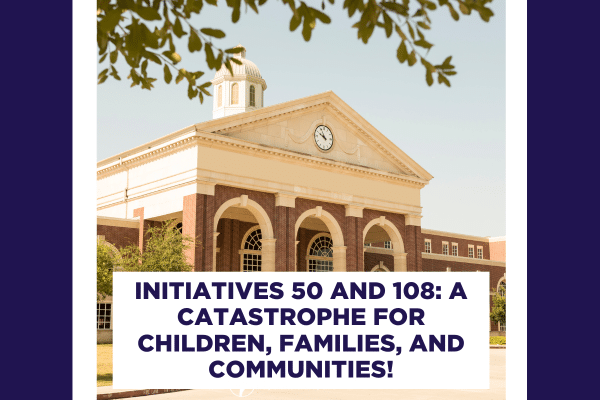
Statement from the Colorado Children’s Campaign on a Special Session to Address Property Taxes
The special session recently called by Gov. Jared Polis offers a path forward for policies that can protect Colorado’s children and families from the potentially devastating impacts of two ballot initiatives that would permanently cut property tax rates and limit property tax revenue.
Removing Initiative 50 and Initiative 108 from the 2024 ballot is the responsible thing to do. These ballot measures pose catastrophic risks to the state and local budgets that support schools and many other vital programs in our communities.
The Colorado Children's Campaign is committed to ensuring that our state government prioritizes children and families in policy and funding efforts.
We encourage legislators to use this special session to focus on a narrow compromise that will help stabilize the state budget and preserve critical programs and services that support kids and families,” said Heather Tritten, President and CEO of the Colorado Children‘s Campaign.
We are particularly concerned that legislators protect recent progress on funding for public schools by ensuring the more equitable and adequate school funding formula that was passed earlier this year goes into effect and by preventing the state from returning to the use of the Budget Stabilization Factor.”
The Colorado Children’s Campaign also calls on the proponents of these measures to stop bringing forth ballot initiatives that would result in extreme cuts to essential services that may not be apparent to voters. The proposals in these ballot measures do not offer constructive solutions to Colorado’s affordability challenges and would harm families and communities by forcing sudden, dramatic, and lasting cuts to services that support their well-being. Colorado needs a productive and civil discourse through open public conversations that offer all Coloradans, and especially our children, policy solutions that support and strengthen the quality, affordable communities they deserve.
The Children's Campaign has created a brief highlighting programs at risk of cuts if these initiatives pass. Read the brief here.
Statement updated August 22, 2024

Colorado Ranks 17th in Child Well-Being; Report Sounds Alarm About Learning Loss, Absenteeism
DENVER, CO — Colorado ranks ninth in family and community context and 17th overall in child well-being, according to the 2024 KIDS COUNT® Data Book, a 50-state report of recent data developed by the Annie E. Casey Foundation analyzing how kids are faring in post-pandemic America. The data shows Colorado leaders must do more to prepare children to learn so they are ready to earn when they reach adulthood. At stake nationally: hundreds of billions of dollars in future earnings and trillions of dollars in lost economic activity.
In its 35th year of publication, the KIDS COUNT® Data Book focuses on students’ lack of basic reading and math skills, a problem decades in the making but brought to light by the focus on learning loss during the COVID-19 pandemic. Unprecedented drops in learning from 2019 to 2022 amounted to decades of lost progress. Chronic absence has soared, with children living in poverty especially unable to resume their school day routines on a regular basis.
In Colorado:
- There was a dramatic increase in the share of Colorado 8th graders who scored below proficient in math on the National Assessment of Educational Progress, or NAEP: 72% of students scored below proficient in the 2022, up from 63% in 2019 – a 14% increase.
- More Colorado 4th graders scored below proficient in reading on the NAEP: 62% of students scored less than proficient in 2022, up from 60% in 2019 – a 3% increase.
- The most recent data show 269,582 students, or around 31% of all kids enrolled in Colorado public schools, were chronically absent in the 2022-2023 school year. (The 2024 Data Book contains 50-state data from 2021-22; some states, including Colorado, have released newer figures that may not be comparable across states.)
- State averages mask disparities that affect students of color, kids in immigrant families and children from low-income families or attending low-income schools.
Nationwide, “less than a third of kids are on pace to have the math and reading skills for the careers of tomorrow, such as those in competitive, well-paying STEM careers,” said Lisa Hamilton, President and CEO of the Annie E. Casey Foundation. “Kids of all ages and grades must have what they need to learn each day, from enough food and sleep… to a safe way to get to school… to support like tutoring and mental health services.”
“Recent NAEP results make it clear that the pandemic had a negative effect on many students’ progress in math and reading,” said Madeleine Ashour, Director of Youth Success at the Colorado Campaign. “But gaps in academic outcomes between low-income families and students of color and their peers have persisted in Colorado for decades – and are larger here than in most states. Recent changes to our school funding system have the potential to help address those gaps, but Colorado must continue to intentionally invest in and support our schools and communities so every student has the opportunity to thrive."
Each year, the Data Book presents national and state data from 16 indicators in four domains — economic well-being, education, health, and family and community factors – and ranks the states according to how children are faring overall.
Last year, Colorado saw a drop in the percentage of children in families where the household head lacks a high school diploma. The state ranked fifth-best in the share of children living in high-poverty areas. These and other indicators helped propel Colorado to ninth best in family and community factors. However, the state slipped two spots in the overall rankings for child well-being, largely due to ranking 28th in health factors. Colorado’s child and teen death rate and share of babies born with a low birth weight were both well above the national average. Colorado ranks 25th in the percentage of children without health insurance.
“Thriving and well-funded health, care, and education systems benefit everyone,” said Heather Tritten, President and CEO of the Colorado Children’s Campaign, the state’s member of the KIDS COUNT network. “The connection between health, care, education and overall child well-being has never been more apparent. Children facing fewer disruptions in these key areas are in a better position to achieve academically and thrive as adults.”
The Casey Foundation report contends that the pandemic is not the sole cause of lower test scores: Educators, researchers, policymakers and employers who track students’ academic readiness have been ringing alarm bells for a long time. U.S. scores in reading and math have barely budged in decades. Compared to peer nations, the United States is not equipping its children with the high-level reading, math and digital problem-solving skills needed for many of today’s fastest-growing occupations in a highly competitive global economy.
This lack of readiness will result in major harm to the nation’s economy and to our youth as they join the workforce. Up to $31 trillion in U.S. economic activity hinges on helping young people overcome learning loss caused by the pandemic. Students who don’t advance beyond lower levels of math are more likely to be unemployed after high school. One analysis calculates the drop in math scores between 2019 and 2022 will reduce lifetime earnings by 1.6% for 48 million pandemic-era students, for a total of $900 billion in lost income.
However, some states have delayed spending their share of the $190 billion critical federal pandemic funding (Elementary and Secondary School Emergency Relief, or ESSER) that could help boost achievement. Colorado had spent 79.6% of its funding as of March 31, 2024. The deadline to allocate – not spend – this funding is September 30, 2024. Tens of billions of dollars set aside for schools will vanish forever if states do not act immediately.
The Foundation recommends the following:
- To get kids back on track, we must make sure they arrive at the classroom ready to learn by ensuring access to low- or no-cost meals, a reliable internet connection, a place to study and time with friends, teachers and counselors.
- Expand access to intensive tutoring for students who are behind in their classes and missing academic milestones. Research has shown the most effective tutoring is in person, high dosage and tied directly to the school.
- States should take advantage of all their allocated pandemic relief funding to prioritize the social, emotional, academic and physical well-being of students. As long as funds are obligated by the Sept. 30 deadline, states should have two more full years to spend them.
- States and school systems should address chronic absence, so more students return to learn. While few states gather and report chronic absence data by grade, all of them should. Improving attendance tracking and data will inform future decision-making. Lawmakers should embrace positive approaches rather than criminalizing students or parents due to attendance challenges, because they may not understand the consequences of even a few days missed.
- Policymakers should invest in community schools, public schools that provide wraparound support to kids and families. Natural homes for tutoring, mental health support, nutritional aid and other services, community schools use innovative and creative programs to support young learners and encourage parent engagement, which leads to better outcomes for kids.
###
RELEASE INFORMATION
The 2024 KIDS COUNT® Data Book will be available at www.aecf.org. Additional information is available at www.aecf.org/databook. Journalists interested in creating maps, graphs and rankings in stories about the Data Book can use the KIDS COUNT Data Center at datacenter.aecf.org.
ABOUT THE ANNIE E. CASEY FOUNDATION
The Annie E. Casey Foundation creates a brighter future for the nation’s young people by developing solutions to strengthen families, build paths to economic opportunity and transform struggling communities into safer and healthier places to live, work and grow. For more information, visit www.aecf.org. KIDS COUNT® is a registered trademark of the Annie E. Casey Foundation.