New Bill Would Protect Colorado Students Amid Federal Cuts to Civil Rights Enforcement (02/26/26)
DENVER – A bill introduced in Colorado’s General Assembly this week would create essential state-level infrastructure to protect students with disabilities at a moment when federal protections have been significantly weakened.
The families of 44,040 Colorado students with 504 plans depend on disability rights protections to support their children’s education. But the partial closure of the U.S. Department of Education’s Office for Civil Rights (OCR) has left families without a reliable avenue for complaints and appeals when schools fall short.
By codifying language from Section 504 and the Americans with Disabilities Act (ADA) in state law and providing the Colorado Department of Education with additional resources, Colorado can continue enforcing the civil rights of students with disabilities.
“Colorado cannot afford to wait while federal oversight diminishes,” said Emily Harvey, Co-Legal Director at Disability Law Colorado. “By codifying key protections from Section 504 and the ADA into state law, lawmakers are ensuring that students with disabilities remain protected regardless of shifting federal priorities. Civil rights enforcement must be stable and dependable — not political.”
“This bill protects our most vulnerable students while preventing costly litigation and supporting the education of all students,” said Madeleine Ashour, Director of K-12 Education Policy at the Colorado Children’s Campaign. “When children’s rights aren’t enforced early and consistently, students can go without needed services. Teachers absorb the resulting workload in the short term, so whole classrooms are affected when this happens. Most importantly, students can’t wait – timeliness is key to effective intervention. It’s also key to reducing litigation costs.”
About the bill
Disability Rights Protections in Public Schools (SB26-125):
- Codifies some of the statutory language from Section 504 and the ADA into Colorado law
- Establishes a reasonable complaint procedure families can use at CDE instead of waiting on OCR
- Requires schools to implement annual disability rights training
- Requires schools to ensure school disability rights coordinators are operating according to current state law
The bill does not create new mandates, burdens, or requirements for schools.
Quotes from bill sponsors
This bill is sponsored by Sen. Chris Kolker, Sen. Janice Marchman, Rep. Jennifer Bacon, and Rep. Jacque Phillips.
“The federal government has decimated the oversight and investigation pathways for 504 and ADA complaints. Now, Colorado will step in to protect the rights of our disabled students and staff by enshrining these protections into our state law. This bill is paramount for the protection of those with disabilities in our public education system, and I am proud to be a co-sponsor,” said Sen. Chris Kolker, who represents SD16.
“The U.S. Department of Education Office for Civil Rights, in Denver, significantly reduced their attorney staff. That means legal compliance for students on 504 plans is at risk. If the U.S. Department of Education can’t take care of our students with disabilities, then the Colorado Department of Education will!” said Rep. Jacque Phillips, who represents HD31.
Background: Stepping up where the federal government has stepped back
Colorado has long recognized the importance of supporting students with disabilities in public schools. But the recent dismantling of federal education infrastructure has created a void that the state must now fill.
Two federal laws have protected students with disabilities from discrimination in schools.
- Section 504 of the Rehabilitation Act provides for student accommodations, like extra time on tests, and protection from discrimination.
- The Americans with Disabilities Act (ADA) ensures equal access to learning opportunities and prohibits discrimination.
OCR has historically monitored and enforced Section 504 and the ADA in public school settings. OCR takes complaints, investigates, and supports mediation.
Since May of 2025, half of OCR staff have been terminated, and 7 out of 12 OCR regional offices have closed. As OCR shrinks, its ability to meet caseload demand shrinks. In 2024, OCR issued public decisions on 56 cases. In 2025, it issued 7. When complaints go unresolved, students can face months of bullying, fall behind academically, and experience lasting harm.
Without intervention, districts could face increased litigation and long-term costs to the state could grow significantly. This bill ensures Colorado is not left waiting for a crisis.
Media contacts:
- Jackie Zubrzycki, Vice President of Communications, Colorado Children’s Campaign: Phone: 720-773-8805; Email: jackie@coloradokids.org
- Felix Ortiz, Communications Manager, Disability Law Colorado: Phone: 720-202-9871; Email: fortiz@disabilitylawco.org
###
About the Colorado Children’s Campaign
At the Colorado Children’s Campaign, we use data and research to identify what kids across our state need most, then advocate for policies that strengthen their well-being and help them thrive. Our focus is the whole child, working across Early Childhood, K-12 Education, Health, and Economic Security for the greatest long-term impact.
About Disability Law Colorado
Disability Law Colorado is a nonprofit civil rights organization, authorized by federal law to combat discrimination, abuse, and neglect. We aim to make Colorado the best place in America for people with disabilities to thrive. For more information, visit disabilitylawco.org


Federal Judge Extends Temporary Protection for Child Care and Children’s Basic Needs, but Long-Term Solutions Still Urgently Needed (01/23/2026)
DENVER – While a federal judge has extended a temporary restraining order requiring the federal government to continue funding for Colorado’s subsidized child care program and other public benefits supporting families’ basic needs, the Colorado Children’s Campaign emphasizes that this is just a temporary reprieve. Critical funding remains at risk, and children across the state need permanent solutions.
The Colorado Children’s Campaign continues to urge federal and state leaders to press the White House to permanently restore these essential funds. Without these funds, Colorado families will be unable to work, put food on the table, or meet their children’s basic needs. Colorado children should not be used as pawns for political gains.
It is clearer than ever that Colorado must build a resilient, flexible system to protect kids no matter what happens in Washington. Our 2026 Policy Priorities lay out a path forward, focused on ensuring all Colorado children have access to vaccines, health coverage, a strong safety net, quality child care, and fully-funded schools.
Expert available for comment: Mathangi Subramanian, Director of Early Childhood Policy, is available to discuss the freezes and their implications for Colorado.
Email to arrange an interview: Jackie@ColoradoKids.org, 720-773-8805
###
About the Colorado Children’s Campaign
At the Colorado Children’s Campaign, we use data and research to identify what kids across our state need most, then advocate for policies that strengthen their well-being and help them thrive. Our focus is the whole child, working across Early Childhood, K-12 Education, Health, and Economic Security for the greatest long-term impact.
Download PDF of ReleaseThree Bills Aim to Strengthen Colorado’s Child Care System Amid Federal Uncertainty
Media contact: Dr. Mathangi Subramanian, Director of Early Childhood Policy, is available to discuss these bills and their implications and to connect reporters with early childhood providers who can discuss their potential impact.
DENVER – Three bills introduced in Colorado’s General Assembly this week will make the state’s early childhood education and care system more affordable, efficient, and accessible for families at a moment when federal support for early childhood remains uncertain.
Colorado families face significant challenges accessing care for their children, with nearly 13,000 children on waitlists for child care subsidies or affected by enrollment freezes. The state was recently ranked the fifth most expensive in the country for child care. Recent federal funding freezes have intensified concerns about the future of the state’s most vulnerable families.
“The first years of a child’s life are critical for their development,” said Dr. Mathangi Subramanian, Director of Early Childhood Policy at the Colorado Children’s Campaign. “This year, our lawmakers have the opportunity to cement Colorado’s status as a national leader in early childhood by cutting red tape and investing in systems that ensure every child has access to safe and nurturing care.”
Three Bills to Bolster Early Childhood
-
Continuation of Child Care Contribution Tax Credit (HB26-1004): This bill renews the Child Care Contribution Tax Credit to attract private investment and sustain child care providers. This proven tool expands child care access for families and strengthens local economies, delivering long-term benefits for children and the workforce alike.
-
Early Childhood Local System Consolidation (SB26-019): This bill streamlines the early childhood system by combining administrative structures, making it easier for families to navigate available programs, ensuring funding is used efficiently and wisely, and raising provider quality and accessibility.
-
Child Care Provider Licensing & Quality (SB26-020): This bill makes child care licensing processes more accessible and efficient while maintaining a high level of quality. It also convenes a task force of childhood experts to evaluate our current quality ranking system and suggest improvements.
Together, these bills will maintain a key avenue for revenue; maximize existing resources while simplifying navigation for families; and support provider quality and sustainability.
Strengthening the Early Childhood System
Colorado has taken important steps to support early childhood in recent years. The Colorado Department of Early Childhood was established in July 2022, and the Universal Preschool program has served tens of thousands of children across the state since it launched in 2023.
These bills build on that foundation to ensure the system works effectively and equitably for all families.
“Investing in early childhood at the state level is more necessary than ever before,” Subramanian said. “With our federal funding at risk, we need bills like these to address both immediate needs and long-term sustainability. Together, this legislation reinforces Colorado’s continuing commitment to our children and families, now and in the future .”
Learn More: The Colorado Children’s Campaign 2026 policy priorities

Federal Freeze Puts Tens of Thousands of Colorado Children at Risk; 300+ Organizations and Coloradans Demand Action
DENVER – Tens of thousands of Colorado children are placed in jeopardy by a federal funding freeze that would result in families losing cash assistance, lead child care centers to close, and make it even more difficult for families to find safe places for their children to be cared for while they work.
More than 300 organizations and individuals in Colorado have signed a letter calling on federal officials and the state’s congressional delegation to act so that critical federal funding for child care, families’ basic needs, and social services continues to flow to Colorado.
[READ THE LETTER AND VIEW SIGNATURES]
Earlier this month, the federal department of Health and Human Services (HHS) and the Administration for Children and Families (ACF) froze tens of millions of dollars in funding for Temporary Assistance for Needy Families (TANF), the Social Services Block Grant (SSBG), and the Colorado Child Care Assistance Program (CCCAP).
“While the freeze is currently paused, this action should never have occurred. Programs that support children should never be used in political gamesmanship,” said Heather Tritten, President and CEO of the Colorado Children’s Campaign. “It is particularly disgraceful that these cuts specifically target children in families with low incomes – some of which will face a double blow, losing access to child care and support for basic needs, job training, and other resources all at once.”
The freezes would also have ripple effects for children and families not directly served by the affected programs, as Colorado government agencies would lose funding they use to administer a variety of early childhood programs and child care providers would lose funds that allow them to serve children with and without subsidies.
“Colorado’s child care infrastructure is underfunded even without this freeze. Denying the state this funding is kicking us when we were already down. More than 12,000 Colorado children are on waitlists and freezes for CCCAP, and many more families across the state struggle to find and afford high-quality child care,” said Dr. Mathangi Subramanian,
Director of Early Childhood Policy at the Colorado Children’s Campaign. “If this funding is frozen, it will disrupt the lives of children and families almost immediately. And it will cause serious losses for our state’s communities and our economy as child care providers close and parents can no longer go to work.”
The letter calls for the U.S. Department of Health and Human Services and the Administration for Children and Families to rescind the freeze and for the state’s Congressional delegation to urge the administration to release funds.
“Colorado’s children are its most important asset. We should be investing in every child every day so they can be healthy and thrive,” Tritten said.
Facts and Figures:
- The Colorado Child Care Assistance Program (CCCAP) serves 27,000 children, most of them under the age of 5. Without CCCAP funding, many providers will be forced to close their doors.
- More than 47,000 children in Colorado receive basic cash assistance through the Temporary Assistance for Needy Families program (TANF). These children live in families with household incomes under $15,000 per year and TANF helps their families afford necessities like diapers, food and clothing.
Learn More:
- Read the Colorado Children’s Campaign’s statement on the funding freeze
- Coloradans who are concerned can reach out to their representatives using the Colorado Children’s Campaign’s action alert
Statement on Shooting at Evergreen High School
Our deepest sympathies are with the Evergreen High School community.
“Children need and deserve to be able to attend school without fear,” said Heather Tritten, President and CEO of the Colorado Children’s Campaign. “We must work together to end gun violence so that no other child experiences a school shooting. And we must take care of those who are suffering today.”
Resources for students, schools, parents, and communities
- CDPHE Office of Gun Violence Prevention: Office of Gun Violence Prevention | Colorado Department of Public Health and Environment
- Gun violence resources from the Office of School Safety: Gun Violence Prevention | The Office of School Safety
- National Child Traumatic Stress Network: School shooting resources
- SAMHSA: Coping with traumatic events
- American Psychological Association: Coping with shootings
- University of Michigan: Resources for Communities After a School Shooting | Institute for Firearm Injury Prevention (umich.edu)
- Second Wind Fund: Second Wind Fund – Youth Suicide Prevention (thesecondwindfund.org)
Resources for crisis support:
- Colorado Crisis and Support Line: 844-493-8255, or Text TALK to 38255
- Safe2Tell Colorado: 877-542-7233

Coloradans launch 2026 ballot push for graduated state income tax
DENVER, CO — September 3, 2025 — The Protect Colorado’s Future coalition today announced plans to put a graduated income tax on the 2026 ballot. This proposal would lower taxes for 98 percent of Coloradans, while raising taxes on individuals and corporations making more than $500,000 a year.
The proposal comes in direct response to Colorado’s budget crisis, caused by state revenue limits and federal budget cuts. This budget gap has led to $1.5 billion in cuts to vital state programs this year alone. The state’s existing budget squeeze forced massive program cuts earlier this year, but President Trump’s “One Big Beautiful Bill Act” threw our state into free fall, taking away funds for healthcare, food assistance, and schools to benefit giant corporations and give tax breaks to the wealthiest.
Protect Colorado’s Future says it’s time to fix the state’s tax system. For 50 years, Colorado used a graduated income tax system, in which those with higher incomes paid higher taxes. This system ended in 1987, when an anti-tax legislature replaced it with an inequitable “flat tax,” lowering taxes on those making the most and gradually draining the state budget. The coalition aims to ask voters to fix that injustice through a ballot measure in 2026, and began that process today by filing three versions of a ballot initiative.
“Colorado is at a turning point,” said Chris deGruy Kennedy, President and CEO of the Bell Policy Center, a member of the coalition. “For more than three decades, an upside-down tax code has hurt Colorado’s schools, health care, childcare and the environment. We’ve made the wealthy even wealthier while everyone else struggles to keep up. The cruel cuts to healthcare and the absurd corporate tax giveaways in the federal budget bill have pushed Colorado over the edge, and only the voters of Colorado have the power to make the wealthy pay their fair share and restore funding to critical state priorities.”
Colorado is especially vulnerable to federal cuts because a state constitutional amendment called the Taxpayer’s Bill of Rights, or TABOR, creates an arbitrary budget formula that legislators must follow, restricting the state’s ability to fund essential public services. The amendment also makes the 1987 flat tax permanent, unless overturned at the ballot. The result is seen in this year’s state budget: a $1.2 billion dollar deficit impacting every Coloradan, from young children to older adults, in all parts of the state.
“Our generation is tired of waiting for someone else to save our future while our economic security gets worse with every failed minimum wage increase, additional hundreds of dollars added to our rent, and funding cuts to programs we rely on like Medicaid and Higher Education,” said Christina Soliz, Executive Director of New Era Colorado, another member of the coalition. “While the wealthy continue to thrive, young people are questioning whether Colorado is even a feasible place to build their lives. We’re taking our future into our own hands, and that begins with demanding the wealthy pay their fair share."
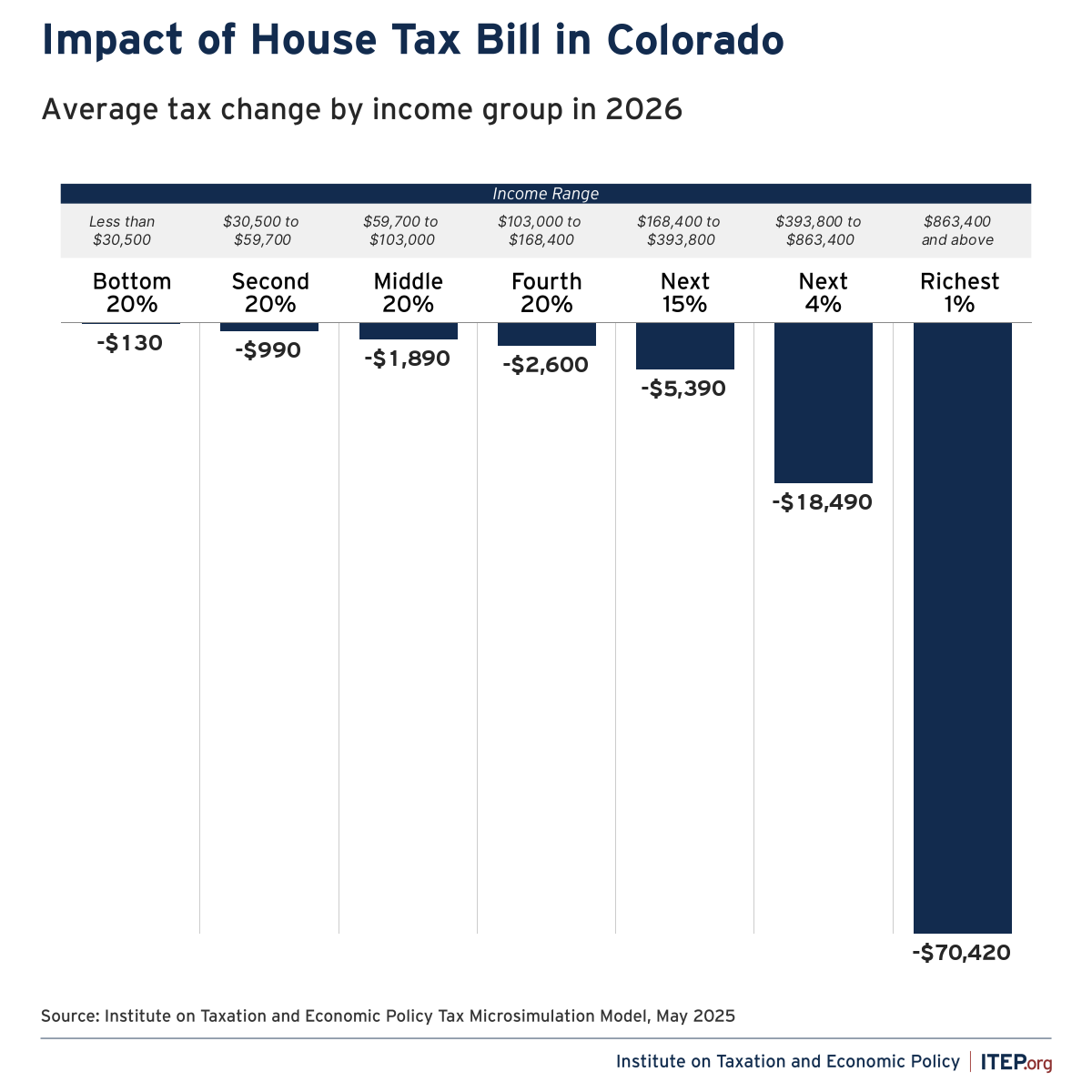
The graduated income tax proposal will help recapture some of the $71,000 the wealthiest Coloradans will receive in 2026 from Trump’s tax cuts, reinvesting those dollars back into classrooms, healthcare, childcare, and other state priorities that could include food security, public safety, or workforce development programs.
Additional quotes from member organizations
- Brace Gibson, Policy Director at Colorado Blueprint to End Hunger: “It’s time to put people first and build a fairer tax system that ensures every Coloradan can meet their basic needs like putting food on the table. Outdated policies like TABOR and federal tax breaks for the wealthy make that harder. We can and should do better by investing in food access, schools, healthcare, transportation, and other essential services that all of our communities rely on.”
- Kathy White, Executive Director at Colorado Fiscal Institute: “Colorado’s working families shouldn’t have to pick up the tab so the wealthiest get a $71,000-a-year gift from Congress — especially when TABOR has already tied our hands for decades. A graduated income tax is just common sense: 98% of us get a tax cut, and the folks doing really well chip in a fair share to keep our schools strong, our healthcare system solid, and our communities thriving. That’s how we build a Colorado where everyone gets ahead, not just the lucky few.”
- Heather Tritten, President and CEO of the Colorado Children’s Campaign: “A new approach to income taxes would open up a world of opportunity for Colorado's children and communities. Imagine a future where Colorado can build the schools, health care system, child care supports, and strong, safe, generous communities our children need and deserve. Imagine a future where our state's resources match the true prosperity of our communities. Imagine a future where we are not as vulnerable to the whims of federal policymakers. This proposal is a step toward that future.”
About the Protect Colorado’s Future coalition
Protect Colorado’s Future is a coalition of concerned Coloradans represented by the following nonprofit organizations:
Colorado Blueprint to End Hunger
Colorado Center on Law and Policy
Colorado Consumer Health Initiative
Colorado Cross-Disability Coalition
Colorado Organization for Latina Opportunity and Reproductive Rights
Colorado Statewide Parent Coalition
Counties & Commissioners Acting Together
Colorado Finally Receives 2025 Federal School Funding, but Kids and Schools Deserve Consistent Investment
DENVER - A week ago, Colorado was still missing more than $64 million in federal education funding intended to support kids’ learning in the 2025–26 school year. These are dollars Congress had already approved and committed to states. The federal government's Office of Management and Budget (OMB) had delayed releasing them, wreaking havoc in school budgets across the state.
Thanks to a multi-state lawsuit and swift, successful bipartisan advocacy by educators, community leaders, the Governor, and Colorado’s congressional delegation, the administration released $13.6 million in Title IV-B funds last week to support after-school and summer enrichment through 21st Century Community Learning Centers.
Now, following additional public pressure from lawmakers and states, the administration has announced the release of the remaining funds—roughly $5 billion nationally, including the more than $64 million still owed to Colorado. These include funding for English learner education, professional development for educators, school safety, technology, and migrant students. [More on the missing funds.]
“These education funds are a critical investment in communities and children,” said Madi Ashour, Director of K-12 Policy at the Colorado Children’s Campaign. “They bring Colorado taxpayers’ money back to our state in the form of targeted, effective services and programs that help build great schools for kids.”
This is an important step forward. But the delay in funding has already disrupted critical planning and programming for Colorado’s school districts, just weeks before students return to the classroom.
“Unlike other states, Colorado can’t easily plug surprise budget leaks like these,” said Madi Ashour, K-12 Policy Director at the Colorado Children’s Campaign. “We’re relieved the 2025 funding has been restored, but the uncertainty this episode caused, combined with the ripple effects of the budget bill Congress passed this summer, is already taking a toll on our schools.”
The Colorado Children’s Campaign urges federal leaders to take steps to prevent future disruptions to essential K–12 education funding. Consistent, timely investment is essential so that all children in Colorado have access to strong schools and opportunities to learn and grow.

Press Release: Children’s Campaign calls for federal government to remove ban on a Colorado health coverage policy that supports babies and toddlers
In this release
- New data on children ages 0-3 in each Congressional district who would be affected by a new federal ban on continuous enrollment policies.
- New, first-of-its kind report highlighting cost savings, health benefits resulting from continuous enrollment policies during COVID-19 pandemic
- Information about continuous enrollment in Colorado and the impact of recent federal policy changes.
DENVER – The Colorado Children’s Campaign is calling on federal policymakers and our congressional delegation to support children's health and reduce health care costs by allowing Colorado and other states to provide continuous enrollment in public health coverage to babies and toddlers.
The federal Centers for Medicare and Medicaid Services (CMS) announced this month that states are prohibited from implementing policies that would keep young children enrolled in public health coverage, despite evidence that they save money and promote health. Colorado planned to provide continuous enrollment in Medicaid or Child Health Plan Plus (CHP+), which offer health coverage to children in low-income families, to eligible children under 3, beginning in 2026.
This will affect almost 144,000 Colorado babies and toddlers who are enrolled in Medicaid or CHP+, potentially increasing state and federal spending for their medical bills and reducing their access to health care.
The biggest impacts will be felt in Congressional District 8, which includes parts of Adams, Weld, and Larimer County, and District 4, which includes much of the Eastern Plains and parts of the Front Range.
| Congressional District | Babies & Toddlers Enrolled in Medicaid or CHP+, 2024 |
| District 1 (DeGette) | 20,802 |
| District 2 (Neguse) | 11,294 |
| District 3 (Hurd) | 16,554 |
| District 4 (Boebert) | 21,939 |
| District 5 (Crank) | 16,047 |
| District 6 (Crow) | 19,658 |
| District 7 (Petterson) | 12,556 |
| District 8 (Evans) | 25,003 |
Source: Center for Improving Value in Health Care (CIVHC)
Note: Data include children under 3 years old who were enrolled in Medicaid or CHP+ for at least one month in 2024.
“The federal government is interfering with Colorado’s ability to save taxpayers money while promoting the health of our state’s youngest children,” said Toni Sarge, the Director of Health Policy at the Colorado Children’s Campaign.
“Health insurance is extremely expensive and is expected to get significantly more expensive next year because of the spending bill Congress passed this summer,” Sarge said. “The earliest years of a child’s life are often the years when a family’s economic stability is most tenuous and a parent is least able to spend thousands of dollars each year on coverage – let alone on medical bills. Continuous enrollment would help kids stay healthy and help their families – and the state – stay afloat financially.”
The Colorado Children’s Campaign calls on CMS to support states’ ability to introduce similar policies that support kids’ health. The Campaign also supports new efforts in Congress to provide continuous health coverage to low-income children.
New Evidence of Continuous Enrollments’ Benefits for Health, Costs
This announcement comes as the Colorado Children’s Campaign is releasing new evidence of the benefits of continuous enrollment policies for health and health care costs. The report, “The Impact of Continuous Medicaid and CHP+ Enrollment on Children in Colorado,” was produced by the Center for Improving Value in Health Care (CIVHC) on behalf of the Colorado Children’s Campaign, with the support of the Health Equity Fund, an initiative of The Colorado Health Foundation dedicated to advancing health equity across Colorado.
Researchers from CIVHC used real Coloradans’ health records to examine for the first time the health and financial implications of continuous enrollment policies, with a focus on children ages 3 and under.
Researchers found that when children kept health coverage consistently in the early years of the COVID-19 pandemic, families and the government spent less money on their health care and children were more likely to see a doctor for preventive care and less likely to be hospitalized.
The report’s findings include:
Continuous enrollment policies during the pandemic saved Colorado families and taxpayers money
- In 2022, average total medical bills were 3.2 times higher for children under 3 without continuous coverage than for children with continuous coverage
- In 2024, the families of children under 3 without continuous coverage spent an average of $2,000 more on medical bills than the families of children with continuous coverage
- Colorado could have saved up to $63 million in state, federal, and family spending in 2023 by giving all young kids continuous coverage
Continuous enrollment kept Colorado kids healthier and helped them get care in the right place at enrollment right time.
- In 2024, kids with continuous coverage were 1.5 times more likely to see a primary care doctor.
- In 2022, kids without continuous coverage were 7.5 times more likely to be hospitalized – which can be evidence that children did not get needed preventive care in a more appropriate setting when they needed it or that they lack a health care home.
- In 2022, kids without continuous coverage were 4.5 more likely to be readmitted to the hospital within 30 days.
“During the pandemic, continuous enrollment worked – helping children get well-child visits when they need them, reducing hospitalizations, cutting families’ medical costs, and saving the state money,” Sarge said. “States should be able to learn from this successful policy. CMS’s new rule is a step backwards for efficiency and, most importantly, for children’s health.”
Policy Context
From 2020 until the end of 2023 or the beginning of 2024, people who were enrolled in public health programs like Medicaid or CHP+ could maintain health coverage without having to constantly submit paperwork to prove their eligibility, regardless of changes in income or family circumstances. This temporary federal policy change, known as continuous enrollment, was intended to support people’s access to health care during the COVID-19 pandemic.
In 2023, Colorado’s legislature passed a law that built on the results of this successful policy. Babies and toddlers who have been enrolled in Medicaid would keep health coverage continuously before the age of three, beginning in 2026. The goal of this policy is to improve children’s health outcomes and reduce the administrative burden on families and the state.
Media Advisory: $80 million in federal funding for Colorado schools missing; implications of One Big Beautiful Bill
DENVER – The Colorado Children’s Campaign is available to comment on two recent federal policy developments that have implications for the well-being of Colorado children: The passage of the One Big Beautiful Bill, and the nearly $80 million missing from Colorado school districts.
One Big Beautiful Bill and kids’ health coverage, food benefits, and more
Last week, Congress passed a bill that dramatically changes how the federal government is using its resources. And Colorado's children, especially those in low-income families and immigrant households, will bear the brunt of those changes. Kids will lose support for food, health coverage, and other basic needs as a result of the One Big Beautiful Bill.
The Children’s Campaign team is analyzing what this bill means for Colorado children and has published a blog post highlighting provisions that will affect children's health coverage, food security, and more. These include:
- New work requirements for parents of older children and increased eligibility checks will strain Colorado’s system, and changes to the Affordable Care Act marketplace will make health coverage less affordable.
- New work requirements, changes to the state’s funding responsibility, and changes to eligibility will likely lead to reduced SNAP benefits or coverage for kids.
- The Child Tax Credit increases temporarily for some families – but not those who need it most.
- Changes to student loans could affect the early childhood workforce and other professionals who provide essential care.
- Increases in funding for immigration enforcement will affect children’s well-being.
Missing federal funding for schools and education
Nearly $80 million in federal funding that had been committed to schools has not yet arrived, just weeks before school starts. Without these funds, districts will face immediate cash flow challenges that threaten everything from professional development to mental health support. The state typically begins distributing these funds in July, allowing school districts to pay staff salaries, launch summer and early-year programming, and provide vital services for students. The Children's Campaign has published a blog post describing the missing funding and why it matters.
Here’s what’s missing:
- Title 1-C (Migrant Education) $7,895,641: Supports Colorado’s 4,000+ migrant students (kids whose parents travel seasonally for U.S. agriculture jobs).
- Title II-A (Effective Instruction) $25,973,650: Pays for professional development, hiring and retaining of high-quality teachers.
- Title III-A (English Language Acquisition) $11,140,491: Supports academic resources for English-learning students.
- Title IV-A (Flexible Block Grant) $13,529,610: Money that schools can spend to provide well-rounded learning experiences, improving school conditions for learning, or technology and digital literacy skills.
- Title IV-B: (Out-of-school Time Academic Enrichment) $13,609,461: Provides after-school and summer learning programs in high-poverty areas to support working families.
- CDC Grant for Improving Student Health and Academic Achievement $264,145: Supports healthy eating, physical activity, and the management of chronic conditions in schools.
- Adult Education and Family Literacy $2,151,197: Equips parents and adults with the foundational skills and knowledge necessary for economic self-sufficiency.
If Congress does not act, here is what is at stake for Colorado’s students and schools:
- Districts will face impossible trade-offs between school safety, student mental health, arts, STEM, and enrichment—critical supports funded across Title II, III and IV funding. Safe, welcoming schools support working-class families, improve learning, and prevent gun violence and youth substance abuse.
- Thousands of educators will go without the professional learning and instructional support funded by Title II. High-quality instruction is the biggest driver of improved student outcomes.
- Over 120,000 multilingual learners across Colorado could lose access to targeted language development and family engagement programs under Title III. MLs are in almost every classroom in Colorado. All students suffer when their classmates suffer.
- Rural districts and small systems—where federal funds represent a larger share of the budget—will be disproportionately harmed.
The Children’s Campaign is calling on Congress to clarify the status of this funding and make sure that this money reaches Colorado children.
Statement: Federal requests for Colorado Medicaid data put kids at risk
DENVER – The safety, health, and privacy of thousands of Colorado children is at risk due to an unprecedented request from the Centers for Medicare and Medicaid Services (CMS) for our state to share the personal data of people who get health coverage through Colorado’s Medicaid program, including their addresses and immigration status.
Colorado families trust our health care system and providers with the health and safety of their children,” said Heather Tritten, President and CEO of the Colorado Children's Campaign. “This request is already stirring fear and uncertainty for the thousands of Coloradans who have taken a step to support their families’ health by enrolling in public health coverage. Sharing this data would be a devastating betrayal of their trust.”
The Associated Press reports that CMS has already shared the personal information of Medicaid enrollees from other states, including their immigration status, with the Department of Homeland Security.
Colorado provides public health coverage for children and pregnant women who are undocumented immigrants through programs like Emergency Medicaid and Cover All Coloradans. Having health coverage as a child is associated with positive health and educational outcomes and also supports the financial stability of families and health providers.
While our immediate concern is for Colorado’s immigrant community and immigrant children, we should all be concerned about the implications of this request,” Tritten said. “This information is collected so that our state can effectively provide health coverage to people who need it. It was never intended to be used to target individuals for immigration enforcement.”
The Colorado Children’s Campaign commends Colorado’s efforts to make sure that children can go to the doctor when they need to and that families are not needlessly bankrupted by medical bills, regardless of their immigration status. Providing health coverage for children is an investment in our state’s future.
More than one in three children in Colorado – nearly 580,000 children – have health coverage through Medicaid. As of this spring, approximately 10,000 children had coverage through Cover All Coloradans, which serves immigrant children and pregnant women regardless of immigration status.
The Colorado Children's Campaign calls on Colorado's leaders to continue to protect this data and commit to making our state a place where all children and families can thrive.