Every year, the Colorado Children’s Campaign releases the KIDS COUNT in Colorado! Data Book to make sure that children’s needs stay on the forefront of everyone’s minds. When kids have what they need to thrive, they can just be kids. The KIDS COUNT in Colorado! Data Book helps us understand how we are doing as a state and as a community.
This year, the data tell a too-familiar story: Too many families still experience poverty; too many children lack access to health coverage and to pediatricians; and too many students are not meeting academic standards in school.
It’s time we stop accepting these trends as inevitable and make real change. We hope this report serves as a call to action. Every child needs food, stable housing, and a safe place to grow and learn. Every child should be able to see a doctor when they need one. And every child must get the support they need to learn to read. It’s time we get Colorado’s kids – all of them – the resources they need to reach their full potential.
With that in mind, here are four takeaways from this year’s report:
Too many kids are not getting the support they need to learn to read.
The ability to read in third grade is a key predictor of success later in life. But nearly 60% of Colorado third graders are not proficient in reading – and reading scores for older students are similarly low. This trend is consistent across the U.S., and it points to the need to make sure kids are getting what they need – inside and outside of the classroom – to grow their academic skills.
It is getting harder to find and afford health care and child care.
Health care and child care are essential services children and families need to thrive. Yet across Colorado, both are limited in supply and hard to afford. About 70% of kids cannot easily get to a pediatric health professional. Meanwhile, the share of uninsured children is rising, making it harder to afford care when it is available. Similarly, Colorado only has enough licensed child care to serve 13% of infants and 29% of toddlers. And even when seats are available, most families cannot afford child care because it costs over one-third of their entire earnings.
Lack of access to support affects low-income kids the most.
About 74% of low-income 8th graders cannot read or write on grade level, compared with 45% of their higher-income peers. The uninsured rate among low-income children doubled in a single year, from roughly 5% to 10%. And low-income families cannot afford licensed child care at all, leaving parents with few safe options. Our policies and our communities must address these children’s needs.
Federal programs are a lifeline for hundreds of thousands of children.
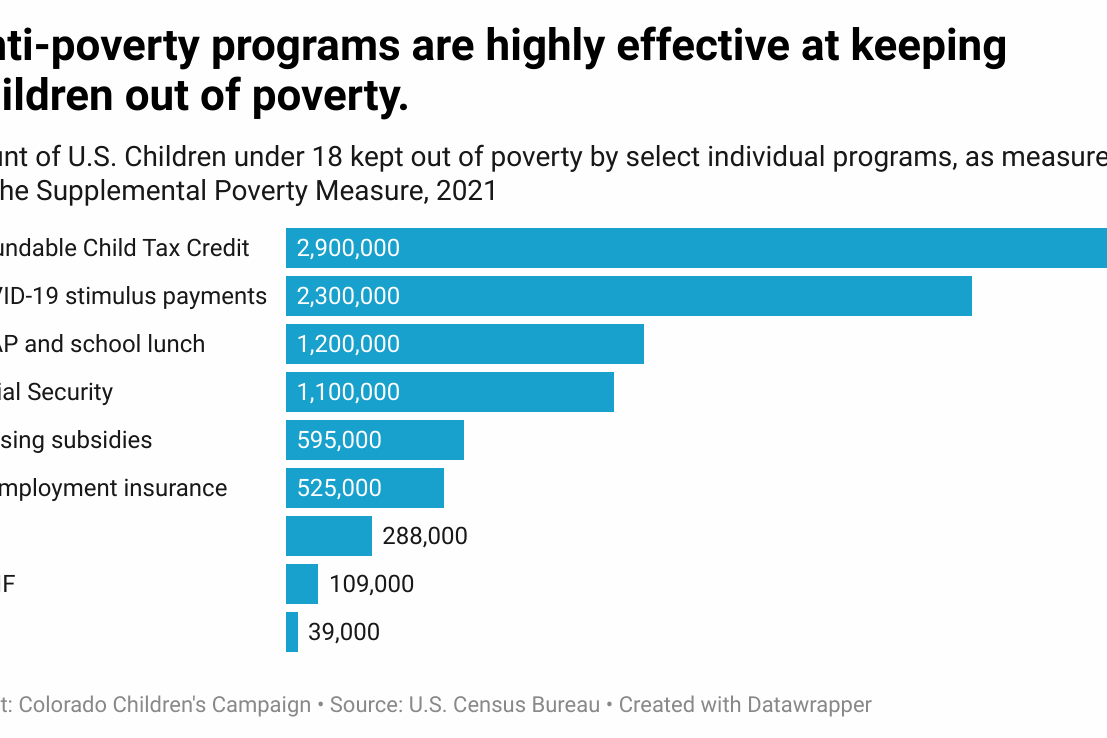
While families work towards higher earnings, federally funded programs are making sure hundreds of thousands of Colorado’s kids are still getting their basic needs met. Medicaid and CHP+ provide health coverage to over 616,300 children, and SNAP delivers food assistance to nearly 355,000 kids. TANF supports 50,500 children in the deepest poverty, and CCCAP provides child care to roughly 27,600 low-income, working families. These programs aren’t the only answer to getting kids what they need, but they are essential for so many Colorado families. Protecting these programs – and pushing for improvements – is an important way we can start to fill the gaps.