The Future of Children's Health Coverage in Colorado
This report from the All Kids Covered coalition reviews the benefits of health coverage and presents policy considerations for insuring Colorado's kids.
The Future of Children's Health Coverage in Colorado
Prenatal Health and Care - Part 1 of 3 in the Ready, Set, Go! Series
Ready, Set, Go: Investing in Infants and Toddlers is a three-part series by the Colorado Children’s Campaign that explores how the foundations for lifelong success start in the earliest stages of life, beginning with a healthy mother and continuing through early childhood. The first of the series, this brief offers policy recommendations to improve preconception and prenatal health. Subjects of focus include prenatal nutrition and physical activity, substance abuse, physical safety, access to healthcare coverage, oral health, and mental and emotional health.
Prenatal Health and Care - Part 1 of 3 in the Ready, Set, Go! SeriesBirth and Healthy Development - Part 2 of 3 in the Ready, Set, Go! Series
The Colorado Children's Campaign's three-part series of briefs, Ready, Set, Go: Investing in Infants and Toddlers, is intended to help frame the discussion around children from the prenatal stage to age three and emphasize the importance of health, education, and family and community supports in helping them grow into strong individuals. Part two in the series, this brief contains policy recommendations related to healthy births, developmental screenings, physical safety, immunization, nutrition and physical activity, health care coverage, and oral health.
Birth and Healthy Development - Part 2 of 3 in the Ready, Set, Go! SeriesQuality Early Care and Learning - Part 3 of 3 in the Ready, Set, Go! Series
This is the final brief in our three-part series, Ready, Set, Go: Investing in Infants and Toddlers. The series is intended to help frame the discussion around children from the prenatal stage to age three and emphasize the importance of health, education, and family and community supports in helping them grow into strong individuals. This particular brief includes policy recommendations that improve early learning and expand access to high-quality, affordable child care.
Quality Early Care and Learning - Part 3 of 3 in the Ready, Set, Go! SeriesMoving Families Forward: An Introduction to TANF in Colorado During the Recession
This brief explains changes in funding levels for the federal Temporary Assistance for Needy Families (TANF) block grant, one of the more important sources of support for low-income families with children. It also explains how the TANF block grant affects a range of programs in Colorado, most notably, Colorado Works and the Colorado Child Care Assistance Program.
Moving Families Forward: An Introduction to TANF in Colorado During the RecessionSchool Readiness for All: The Contributions of Family, Friend and Neighbor Care in Colorado
This report explores the topic of Family, Friend, and Neighbor (FFN) care and its part in Colorado's early childhood landscape.
School Readiness for All: The Contributions of Family, Friend and Neighbor Care in ColoradoPreparación Escolar para Todos: Las Contribuciones de la Familia, los Amigos y los Vecinos en Colorado
Este informe explora el tema de la atención a la Familia, Amigos y Vecinos (FFN, por sus siglas en inglés) y su parte en el panorama de la primera infancia de Colorado.
Preparación Escolar para Todos: Las Contribuciones de la Familia, los Amigos y los Vecinos en Colorado2013 Legislative Priorities
The Colorado Children's Campaign has identified a number of priorities for the 2013 legislative session. Focus areas include child health, K-12 education, early childhood, and budget issues.
2013 Legislative PrioritiesDigital Learning in Colorado: Opportunities and Recommendations
 Digital Learning in Colorado
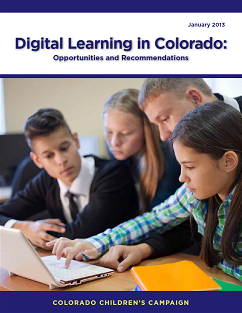 Digital Learning in Colorado
K-12 digital learning is an instructional practice using technology to enhance student learning that has taken root in schools across the country. While the term digital learning encompasses a variety of strategies (such as blended, supplemental and online), most district programs implement blended learning in which learning takes place in part online and in part face-to-face. The Children’s Campaign believes that digital learning offers a variety of benefits to students, including supporting their engagement, helping them access content, assisting their ability to master content and improving their overall academic growth and achievement. As technology continues to advance and make its way into the classroom, the Children’s Campaign seeks to identify ways to ensure that all children have the opportunity for academic success and a strong education.
Opportunities and Recommendations
Digital learning opportunities are diverse in Colorado. From full-time online courses to the “blended” learning that integrates technology and class work, technology in education takes many shapes. It also has the potential to do much more. A new study released by the Colorado Children’s Campaign, “Digital Learning in Colorado: Opportunities and Recommendations,” outlines steps the state could take to extend learning opportunities for all Colorado students.
The new study was requested by the Colorado Legislature last year to learn more about where we are and what’s possible in the future. It found that successful digital learning courses and schools are transforming the educational experience for some students. Now the challenge is to ensure that all students in Colorado have access to high-quality opportunities and that the outcomes of students in online and blended programs are well tracked, understood, and reported.
The Colorado Children’s Campaign believes that if followed, the findings and recommendations of the study have the power to ensure all Colorado kids have access to high quality educational options.
Digital Learning in Colorado: Opportunities and RecommendationsWant to Learn More?
For more information on the Digital Learning Study, please contact:
Leslie Colwell
Vice President, Education Initiatives
Colorado Children’s Campaign
(303) 620-4534
leslie@coloradokids.org
or
John Watson
Founder
Evergreen Education Group
(303) 883-6068
john@evergreenedgroup.com
Click here to download the bill.
Click here to learn more about Evergreen Education Group.
Colorado Children's Budget 2012
State investments in Colorado children have decreased 2 percent per year, on average, in the past five years after accounting for inflation and population growth, according to an annual analysis by the Colorado Children’s Campaign. Five years of state spending examined in the Colorado Children’s Budget 2012 shows that investments in child health, education, and safety are not keeping up with a growing child population.
Less than a third of the state’s total spending is invested in children, according to the analysis. In the current fiscal year, 32 percent of total appropriations were for services impacting children—down from 37 percent in the 2011-12 fiscal year. The annual analysis by the state’s leading voice for kids serves as a resource for state leaders and policy makers as they examine how Colorado finances investments in children. The report breaks down spending into four areas: early childhood development and learning, child health, K-12 education and other support and safety services for children and families.
“There are many signs that the worst of the economic downturn is behind us, and we have an opportunity to be strategic about where we make investments as Colorado’s revenues rebound,” said Chris Watney, President and CEO of the Colorado Children’s Campaign. “Restoring cuts to education and health services that help kids grow up strong should be our first priority, and we’re encouraged by the governor’s state budget proposal for 2013.”
Gov. John Hickenlooper’s proposed budget for the 2013-14 fiscal year includes new investments in early childhood education, K-12 education, and health. In addition, those areas were included as recommendations in the grassroots TBD Colorado process.
Key findings of the report:
- Colorado’s support for early childhood development and learning programs has decreased in the past five years. This trend continues despite solid evidence that shows early childhood investments offer significant returns on investment in the short- and long-term, and are the most efficient and effective ways to ensure school readiness and close achievement gaps.
- Investment in the K-12 education system accounts for two-thirds of all spending on children, but has failed to keep pace with inflation and population growth.
- Health services and programs account for a growing share of the state’s investments in children. The number of uninsured Colorado children has declined in recent years due to efforts at the federal, state, and local levels to get more children insured, as well as increased eligibility for public coverage for families whose incomes have dropped during the Great Recession. This secure, stable health coverage has helped working families ensure children get the care they need, when they need it.
The Colorado Children’s Budget 2012 analysis also shows that during the past five years, investments in programs serving children generally failed to keep up with inflation and child population growth unless they were protected in the state constitution, had a dedicated revenue source or were able to leverage federal matching dollars. As the federal government nears the deadline for averting the “fiscal cliff,” many services including Head Start and child care assistance for working families could be vulnerable to deep cuts.
“Historically, services that children depend on for food, safety and security have been among the hardest hit during tough economic times,” Watney said. “It is both short-sighted and against most Americans’ values to let children suffer as a result of our nation’s inability to thoughtfully resolve the budget crisis.”
Special Thanks to our sponsor, First Focus.
Colorado Children's Budget 2012